Top 5 Groundbreaking Space Discoveries of the Year
This year has been monumental for space exploration. From exoplanets to cosmic phenomena, the discoveries challenge our understanding of the universe.
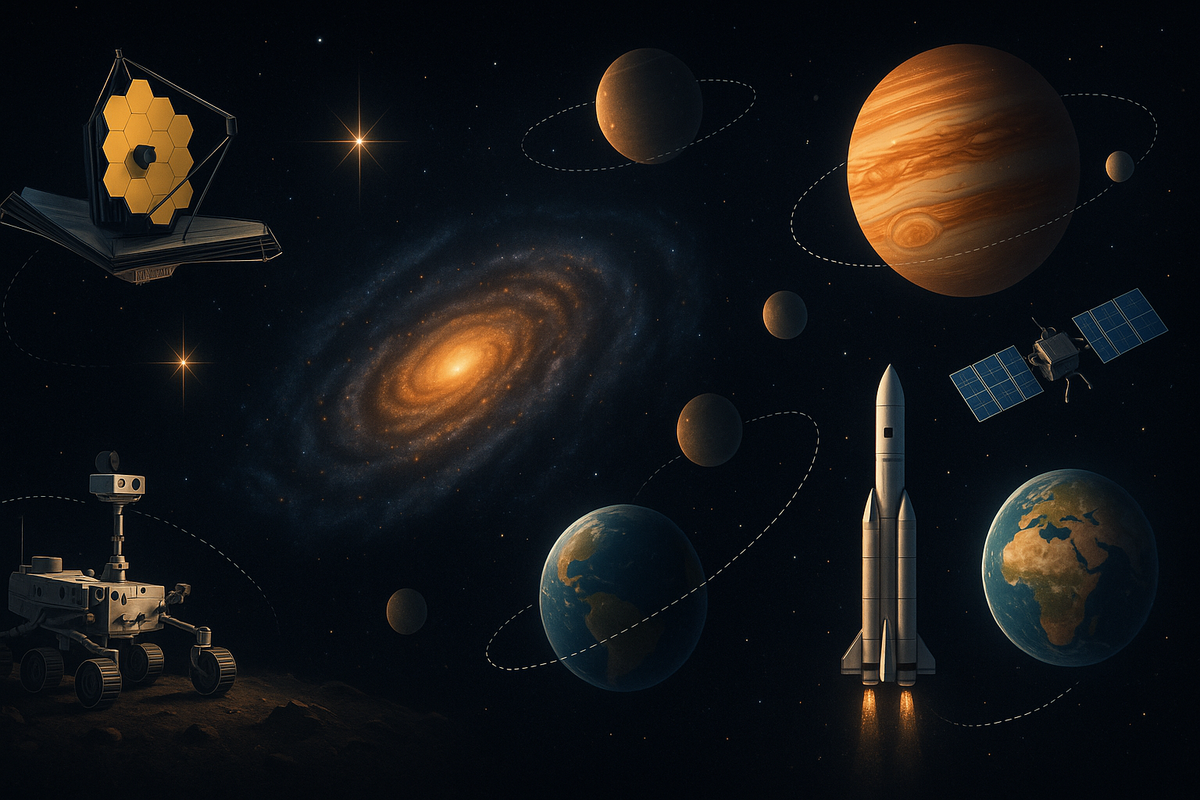
Overview of the Most Exciting Space Discoveries Made in the Past Year
As the universe stretches endlessly beyond our perception, 2023 has brought with it remarkable revelations that deepen our understanding of cosmic phenomena. Among these discoveries, one of the most significant was the detection of phosphine in the atmosphere of Venus, suggesting the possibility of microbial life. Next, astronomers captured unprecedented images of an exoplanet located over 100 light-years from Earth, revealing its atmospheric composition. Another groundbreaking finding involved the first direct observation of a black hole’s magnetic field, providing insights into the enigmatic structure and behavior of black holes.
Moreover, NASA's James Webb Space Telescope (JWST) played a pivotal role in unveiling these mysteries, revolutionizing our approach to cosmic exploration. Finally, the discovery of fast radio bursts (FRBs) originating from a distant galaxy unlocked new lines of inquiry regarding the mechanics of the universe. Each of these breakthroughs not only highlights our current technological prowess but also raises profound questions about our place in the cosmos.
Dive Into the Technology That Enabled These Discoveries
The landscape of modern astronomy has been irrevocably transformed by technological advancements, enabling scientists to peer deeper into the cosmos than ever before. The JWST, launched in late 2021, has been pivotal this year. Its ability to capture high-resolution images and spectroscopic information has opened a new frontier in exoplanet research. With infrared capabilities, the JWST can identify the chemical compositions of distant planets' atmospheres, facilitating the detection of life-sustaining elements such as water and methane.
Additionally, advancements in radio astronomy equipment have made it possible to locate the sources of fast radio bursts with unprecedented precision. Instruments like the Square Kilometre Array (SKA), under construction, will offer insights into these mysterious signals and their origins. Ground-based observatories equipped with adaptive optics technology have also contributed significantly to our understanding of black holes, allowing astronomers to observe their effects on surrounding matter with remarkable clarity.
Implications for Future Space Exploration
The implications of these discoveries extend beyond mere academic interest; they fundamentally alter our trajectory in space exploration. Finding phosphine on Venus, for example, provokes a reevaluation of our preconceived notions about where life can exist in the solar system. It paves the way for future missions directed at exploring Venusian clouds, potentially bringing back samples that could confirm the presence of microbial organisms.
Moreover, the observations of exoplanets open gateways to the search for habitable worlds outside our solar system. Instruments capable of detailed atmospheric analysis could soon be launched, shifting our focus to terraforming possibilities or even human colonization in the long term. The ability to map black holes in greater detail will likely lead to breakthroughs in understanding gravitational waves and dark matter, key mysteries fueling the future of theoretical physics.
Understanding the Universe: A Paradigm Shift
This year's discoveries have ushered in a paradigm shift in our understanding of the universe. The first direct image of a black hole's magnetic field fundamentally alters our conceptual framework regarding these cosmic giants, which play a crucial role in galaxy formation. It indicates that black holes may not only consume matter but also actively interact with their environments in complex ways.
Furthermore, the direct observation of FRBs opens exciting avenues of research into the extreme conditions of the universe. These signals, which last only milliseconds, challenge our current theories of astrophysical phenomena. Understanding these bursts might aid in modeling the behavior of dense neutron stars and even unravel secrets of the universe’s expansion.
Conclusion
The discoveries of 2023 highlight how far we have come in our quest to understand the cosmos but also underscore how much more there is to learn. As we continue to develop advanced technologies and refine our observational capabilities, the potential for new insights grows exponentially. With each revelation, we inch closer to answering the age-old question regarding our place in the universe, reminding us that despite the vastness of space, it is filled with intriguing mysteries and possibilities waiting to be unveiled.